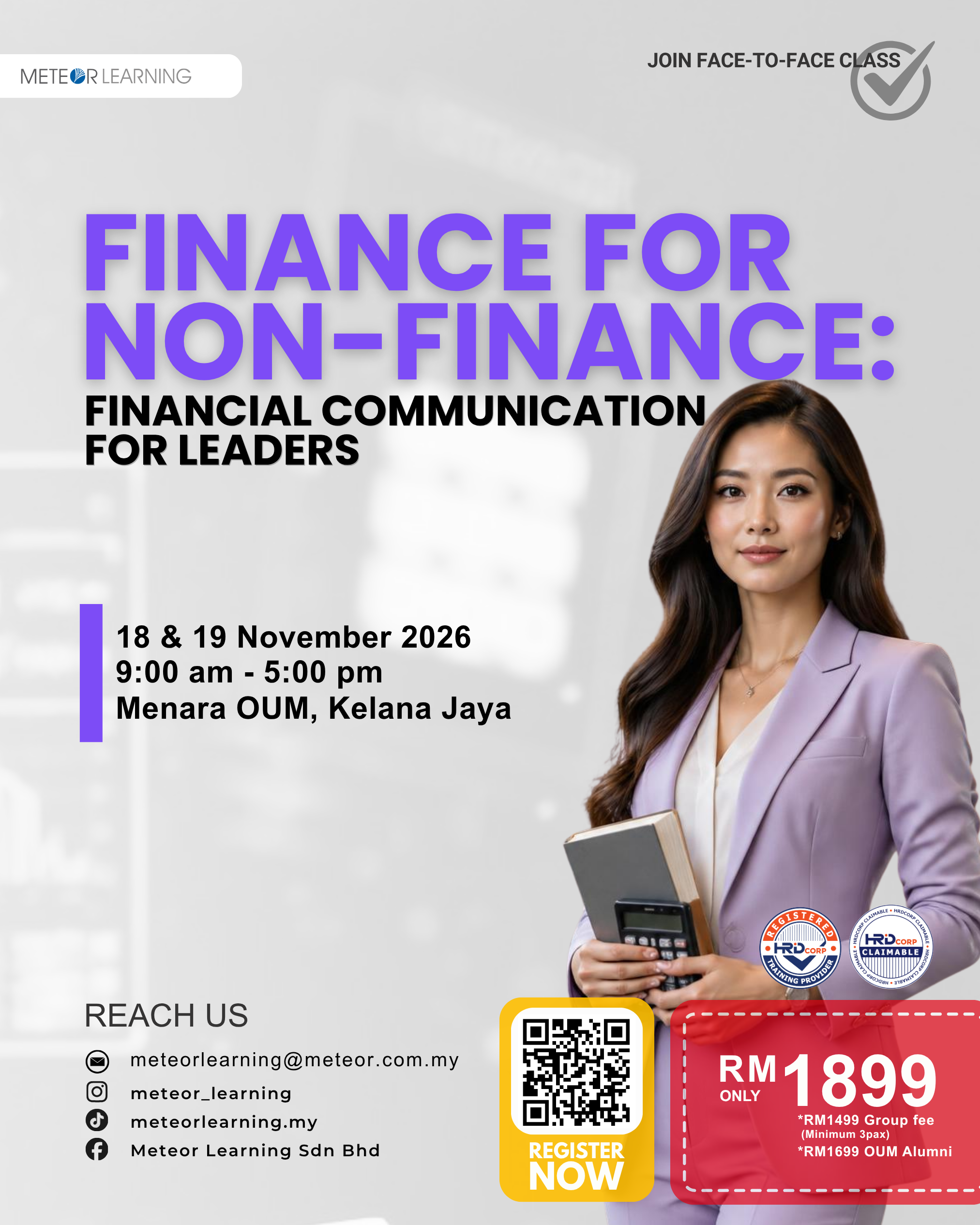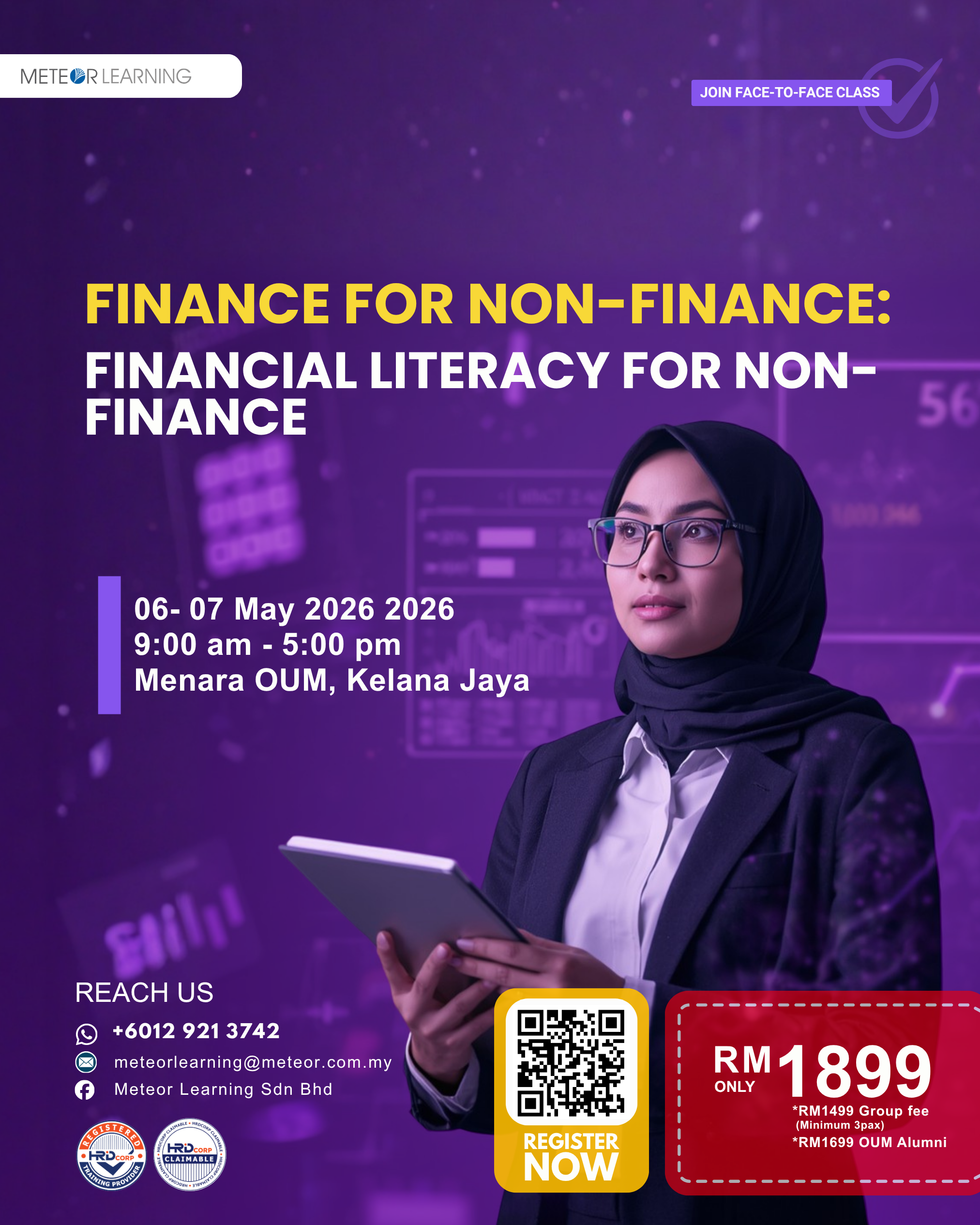
Finance for Non-Finance Professionals
| Workshop Title | Finance for Non-Finance Professionals |
| Trainer | Nik Nur Aisyah binti Nik Md Zain |
| Workshop Duration | 2 Days |
| Workshop Description | Finance plays a pivotal role in every organization, and it’s essential for non-finance managers to have a solid grasp of financial concepts and practices. This two-day training module is designed to provide non-finance professionals with the knowledge and skills necessary to understand and contribute effectively to their organization’s financial decision-making processes. Participants will gain confidence in interpreting financial data, making informed financial decisions, and communicating financial information within their teams. |
| Who Should Attend? | 1. Entrepreneurs and Small Business Owners: People running their own businesses may not have a finance background but need to manage budgets, cash flow, and financial planning to ensure the success and sustainability of their enterprises.
2. Human Resources Professionals: HR professionals can benefit from finance training to understand the financial implications of compensation and benefits decisions, budgeting for HR programs, and overall organizational financial health. 3. Managers and Executives: Leaders in different departments, such as marketing, operations, human resources, or sales, can benefit from understanding financial principles to make informed decisions and contribute to the overall financial health of the organization. 4. Project Managers: Individuals responsible for managing projects need to understand budgeting, cost estimation, and financial analysis to ensure projects are delivered on time and within budget. 5. Engineers and Technical Professionals: Those involved in technical roles may need to understand financial concepts to contribute to cost-effective product development, budgeting for projects, and assessing the financial feasibility of technical initiatives.
|
| Workshop Learning Objective | By the end of this training module, participants will be able to:
1. Understand the fundamentals of finance, including financial statements, key financial ratios, and budgeting. 2. Analyze financial data to assess the financial health and performance of their department or organization. 3. Make informed financial decisions that align with organizational goals and strategies. 4. Communicate financial information effectively to stakeholders and colleagues. 5. Develop a basic understanding of financial planning and forecasting. 6. Identify potential financial risks and take appropriate actions to mitigate them. |
| Workshop Outline | Module 1: Introduction to Basic Finance and Accounting
1. Understand the definition of Asset, Liability, Equity, Expenses and Income. 2. Able to differentiate each item into different classes. 3. Interpreting the function of each item in a situation-based problem. 4. Able to compare types of business entities in Malaysia
Module 2: Accounting Process 1. Show the process of recording a company’s financial transaction. 2. Involves analyzing, summarizing and reporting finance and oversight agencies. 3. Understand the definition on accounting equation and the usage for executives.
Module 3: Financial Statements 1. Overview of the income statement, balance sheet, and cash flow statement. 2. Interpreting financial statements 3. Common financial metrics and ratios
Module 4: Financial Communication 1. Effective communication of financial information 2. Presenting financial data to non-finance stakeholders 3. Building financial literacy within your team and understanding the vision and mission of your company in term of finance.
Module 5: Pricing Strategy 1. Learn the definition of 7 types of pricing strategies. 2. Able to differentiate the pricing strategies based on products.
Module 6: Practical Exercises and Case Studies 1. Group discussions and case studies on real-world financial scenarios 2. Hands-on budgeting and financial analysis exercises 3. Q&A sessions and open discussions
|
| Training Methodology | 1. Slides
2. Handouts (Pre-test and post-test, definition sheets, notes) 3. Group Activity (a) Using physical games for understanding the reasons behind the computation learnt (b) Flash cards (c) Presentation on mock business |
Related Events